Back to Home
Contents

FridgeKey

Smart Fridge Lockers - Make Shared Living Environment More Accountable

This project identifies common problems with shared refrigerators in shared living environments, including unclear food ownership, limited storage organization, and difficulty managing shared space. Inspired by the locker system, FridgeKey extends the idea of individual lockers into a shared refrigerator, creating designated and secure storage for each resident. The system combines physical compartments with digital access and management tools to make shared refrigerator use more organized, traceable, and accountable.

Design Focus
Product Design · Interaction Design
Project Scope
Shared Refrigerator · Smart Lock · Mobile App
Timeline
2026 July - 2026 September
Type
Personal Project

01 / Context & desk research

Background

Food theft is a recurring issue in shared refrigerators. I reviewed reports and discussion posts to understand the problem across dormitories, shared kitchens, and workplaces.

Dorm food theft — shared pain points

Three recurring problems make shared food storage difficult to manage.

01 / Ownership

Clearly labeled food still gets taken

Labels identify a name, but do little to prevent food from being taken. Students also reported that RAs have limited power to intervene.

“Happened to me multiple times freshman year.”
Read the discussion excerpts
“Is stealing food from the common dorm fridges really an issue at Cornell? … At first I thought I was just forgetting I ate my food but I realized people were just eating my things. I’ve emailed my RA about it and she said that she basically can’t do anything other than send an email to our section.”
“One time I put a slice of meat lovers pizza in the fridge and when I took it out to eat it the next day someone had taken all the pepperoni off my slice.”

02 / Access

A personal fridge isn’t a real solution

A mini fridge may seem like an easy workaround, but it is not affordable for everyone. Many high school dormitories also prohibit private refrigerators.

“How do I stop people from eating my clearly labeled food from the communal fridge?”
Read the discussion excerpt
“Ask a parent to help you obtain a mini fridge? Ask a roommate if y’all could split costs on a fridge? Ask a friend with a fridge if you could leave your food in there?”
03 / Accountability

Responsibility is hard to identify

Without evidence, food theft becomes difficult to investigate. Residents struggle to identify who is responsible or resolve the issue.

“This girl would steal my food then blame it on the neighbors or tell me ‘no you only bought x amount’.”
Read the discussion excerpt
“Don’t room with someone just because you went to the same high school and they were cool from what little hanging out you guys do. Ask me how I know… This girl would steal my food then blame it on the neighbors or tell me ‘no you only bought x amount’.”
Overall key takeaway

Shared food needs clear ownership.

Food theft in shared refrigerators is not simply a storage problem. Even when food is clearly labeled, users still lack a reliable way to establish ownership, control access, and identify responsibility.

02 / User research

Questionnaire

I conducted a questionnaire with 58 participants to further explore food theft and conflicts in shared refrigerators. The responses helped clarify user needs and informed the product direction.

58 participants

Shared living · Food ownership · Access & organization

01

Have you ever shared a refrigerator with others?

All participants · n = 58

79.3%

have shared a refrigerator.

  • Yes4679.3%
  • No1220.7%
02

Have you ever had food taken or consumed by someone else, intentionally or by mistake?

Participants with shared refrigerator experience · n = 46

82.6%

have experienced their food being taken.

  • Yes3882.6%
  • No817.4%
03

If this has happened, what was the situation?

Follow-up · 38 respondents who answered Yes to Q2 · Multiple choice

78.9%

were unsure who took their food.

  • Unsure who took it3078.9%
  • Food was eaten by someone else2463.2%
  • Drinks were consumed by someone else1231.6%
  • Food was moved and could not be found1026.3%
  • Food was opened but not finished25.3%

63.2% reported food being eaten by someone else. Multiple selections were allowed.

04

What impact did this experience have on you?

Follow-up · 38 respondents who answered Yes to Q2 · Multiple choice

84.2%

felt uncomfortable or angry.

  • Felt uncomfortable or angry3284.2%
  • No significant impact2873.7%
  • Lack of trust in shared fridges1642.1%
  • Started using shared fridges less1436.8%
05

Have you experienced unfair space allocation in shared fridges?

Participants with shared refrigerator experience · n = 46

95.7%

have experienced unfair space allocation.

  • Occasionally2247.8%
  • Rarely1226.1%
  • Often1021.7%
  • Never24.3%
06

Have you seen any of the following in a shared refrigerator?

Multiple choice · Number of selections

  • Food left unclaimed for a long time19
  • Messy or dirty refrigerator interior13
  • Expired food12
  • Food with an unpleasant odor11
  • Moldy food9
  • Food of unknown origin9
  • None of the above2

Unclaimed food, hygiene, and freshness all appear in the reported problems.

07

How helpful would these shared refrigerator features be?

Weighted mean · 58 responses · 1 = very helpful, 5 = not helpful

Lower scores indicate greater perceived helpfulness.
FeatureAveragePriority
Fingerprint / password protection2.101
Custom sharing permissions2.242
View door-opening records2.543
Personal dedicated storage compartment3.254
Refrigerator space visualization3.555
Automatically record food storage time3.666
Food expiration reminders3.666

Access protection, sharing permissions, and access records ranked highest.

03 / Listening to shared experiences

Interview

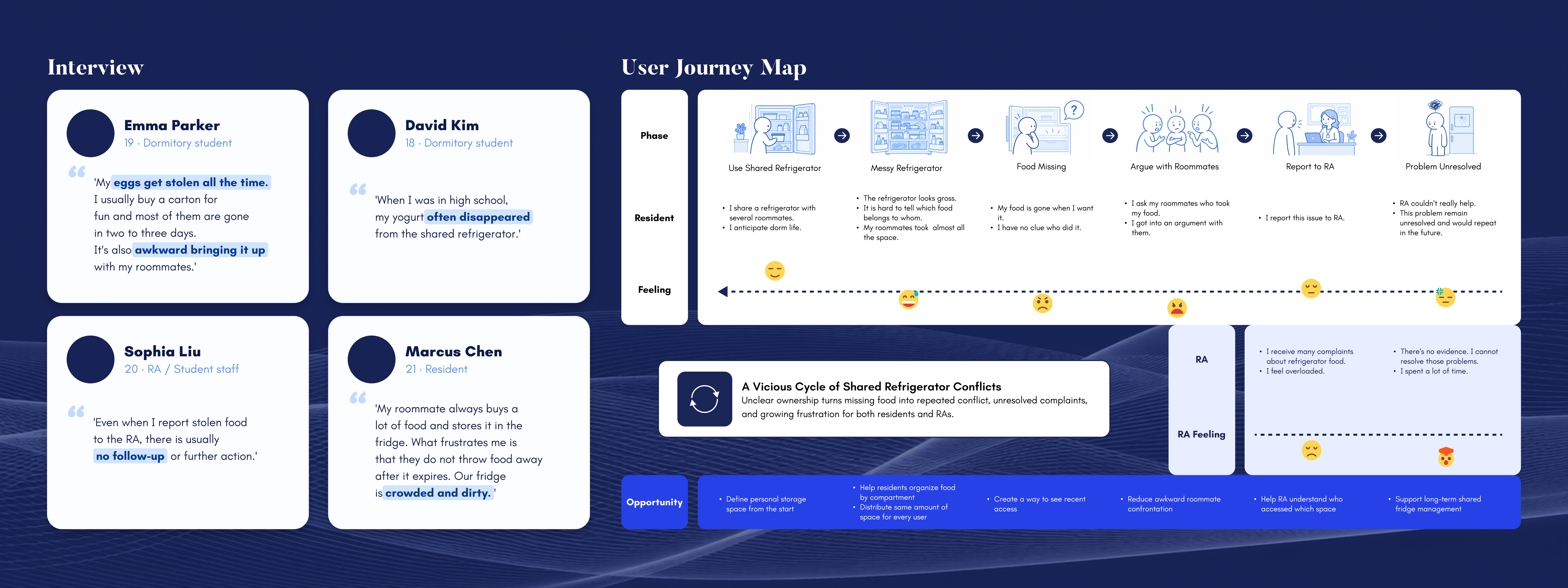
Conversations with current and former dormitory students highlighted the practical and social costs of sharing a refrigerator.

Shijie Bian

21 · Dormitory student

My eggs get stolen all the time. I usually buy a carton for fun and most of them are gone in two to three days. It’s also awkward bringing it up with my roommates.

David Li

35 · Former dormitory student

When I was in high school, my yogurt often disappeared from the shared refrigerator.

Ella Liu

19 · Dormitory student

Even when I report stolen food to the RA, there is usually no follow-up or further action.

Junshi Liu

21 · Dormitory student

My roommate always buys a lot of food and stores it in the fridge. What frustrates me is that they do not throw food away after it expires. Our fridge is crowded and dirty.

04 / Mapping the shared experience

User Journey Map

A missing item can turn into a repeating cycle of uncertainty, confrontation, and unresolved complaints — affecting both residents and RAs.

Follow the resident’s experience, then the RA’s response.

Shared refrigerator journey: resident actions and feelings, RA response, and opportunities.
Phase01Use a shared refrigerator02Messy refrigerator03Food missing04Argue with roommates05Report to RA06Problem unresolved
Resident
  • I share a refrigerator with several roommates.
  • I anticipate dorm life.
  • The refrigerator looks gross.
  • It is hard to tell which food belongs to whom.
  • My roommates took almost all the space.
  • My food is gone when I want it.
  • I have no clue who did it.
  • I ask my roommates who took my food.
  • I get into an argument with them.
  • I report this issue to the RA.
  • The RA couldn’t really help.
  • The problem remains unresolved and may repeat in the future.
FeelingOptimisticUneasyFrustratedAngryDisappointedExhausted
RANot yet involvedNot yet involvedNot yet involvedNot yet involved
  • I receive many complaints about refrigerator food.
  • I feel overloaded.
  • There’s no evidence. I cannot resolve these problems.
  • I spend a lot of time.
RA feeling————WorriedOverwhelmed
Opportunity
  • Define personal storage space from the start.
  • Help residents organize food by compartment.
  • Distribute the same amount of space to every user.
  • Create a way to see recent access.
  • Reduce awkward roommate confrontation.
  • Help RAs understand who accessed which space.
  • Support long-term shared fridge management.

Scroll sideways or use the arrows to explore all six phases.

The cycle

A vicious cycle of shared refrigerator conflicts

Unclear ownership turns missing food into repeated conflict, unresolved complaints, and growing frustration for both residents and RAs.

05 / Synthesizing the research

Persona

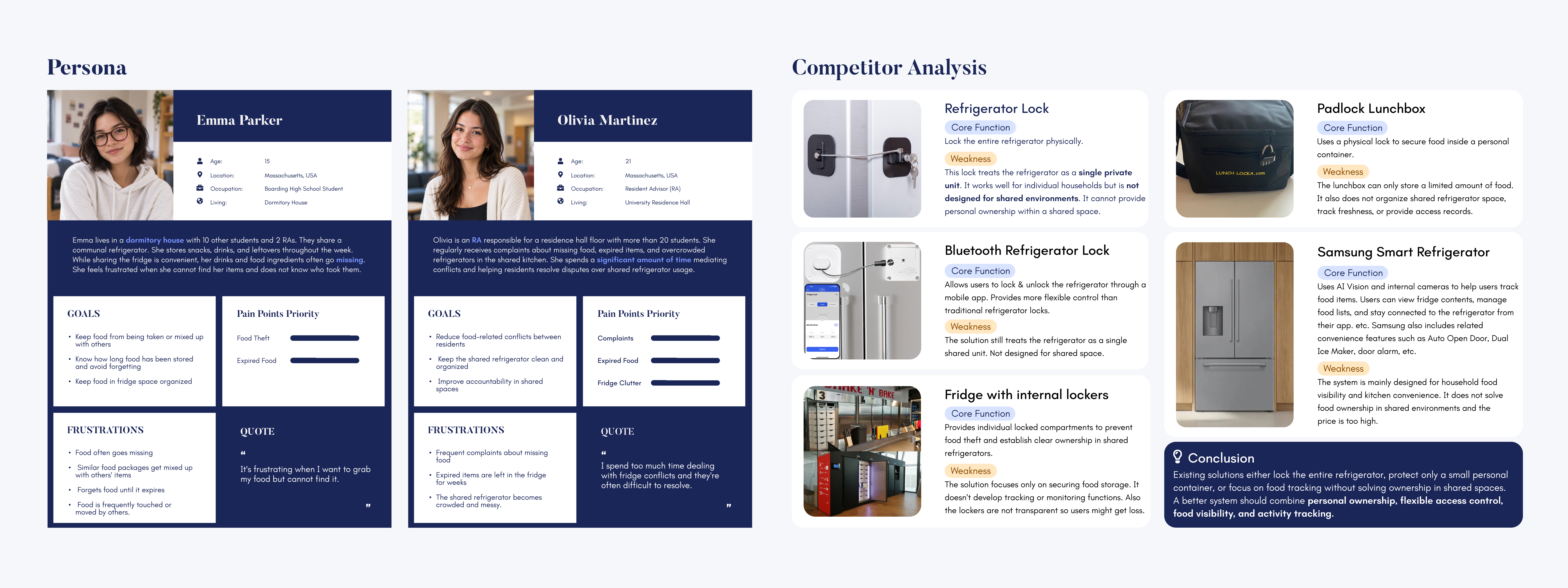
Two perspectives guide the design: residents need ownership and organization; RAs need a clearer way to understand and resolve conflicts.

Resident

Emma Parker

Age
15
Location
Massachusetts, USA
Occupation
Boarding High School Student
Living
Dormitory House

Emma lives in a dormitory house with 10 other students and 2 RAs. They share a communal refrigerator. She stores snacks, drinks, and leftovers throughout the week. While sharing the fridge is convenient, her drinks and food ingredients often go missing. She feels frustrated when she cannot find her items and does not know who took them.

Goals

  • Keep food from being taken or mixed up with others’ items.
  • Know how long food has been stored and avoid forgetting it.
  • Keep food in the refrigerator organized.

Frustrations

  • Food often goes missing.
  • Similar food packages get mixed up with others’ items.
  • Forgets food until it expires.
  • Food is frequently touched or moved by others.

Priority pain points

Food theftExpired food
“It’s frustrating when I want to grab my food but cannot find it.”

Resident Advisor

Olivia Martinez

Age
21
Location
Massachusetts, USA
Occupation
Resident Advisor (RA)
Living
University Residence Hall

Olivia is an RA responsible for a residence hall floor with more than 20 students. She regularly receives complaints about missing food, expired items, and overcrowded refrigerators in the shared kitchen. She spends a significant amount of time mediating conflicts and helping residents resolve disputes over shared refrigerator usage.

Goals

  • Reduce food-related conflicts between residents.
  • Keep the shared refrigerator clean and organized.
  • Improve accountability in shared spaces.

Frustrations

  • Frequent complaints about missing food.
  • Expired items are left in the fridge for weeks.
  • The shared refrigerator becomes crowded and messy.

Priority pain points

ComplaintsExpired foodFridge clutter
“I spend too much time dealing with fridge conflicts and they’re often difficult to resolve.”

06 / Evaluating existing solutions

Competitor Analysis

I compared physical locks, personal containers, smart refrigerators, and compartment-based storage to identify the gap in shared refrigerator use.

Refrigerator Lock

Core function

Locks the entire refrigerator physically.

Weakness

Treats the refrigerator as a single private unit. It works well for individual households, but is not designed for shared environments and cannot establish personal ownership within a shared space.

Padlock Lunchbox

Core function

Uses a physical lock to secure food inside a personal container.

Weakness

Stores a limited amount of food. It does not organize shared refrigerator space, track freshness, or provide access records.

Bluetooth Refrigerator Lock

Core function

Allows users to lock and unlock the refrigerator through a mobile app, offering more flexible control than a traditional lock.

Weakness

Still treats the refrigerator as a single unit, rather than supporting individual access within a shared space.

Samsung Smart Refrigerator

Core function

Uses AI vision and internal cameras to help track food. Users can view contents, manage food lists, and connect through an app. Related convenience features include Auto Open Door, Dual Ice Maker, and a door alarm.

Weakness

Focuses on household food visibility and kitchen convenience. It does not solve food ownership in shared environments, and the price is high.

Fridge with internal lockers

Core function

Provides individual locked compartments to prevent food theft and establish clear ownership in a shared refrigerator.

Weakness

Focuses on secure storage without food tracking or monitoring. Opaque lockers also make it harder for users to find their items.

Conclusion

Connect ownership, access, visibility, and accountability.

Existing solutions either lock the entire refrigerator, protect only a small personal container, or focus on food tracking without solving ownership in shared spaces. A better system should combine personal ownership, flexible access control, food visibility, and activity tracking.

07 / Exploring the product direction

Function Brainstorm

I explored ideas across six areas, then selected the functions that best support personal ownership, controlled access, and shared refrigerator management.

Selected main functionSelected functionOther idea

Showing 22 ideas

Access

  • AppUnlockSelected main function
  • TemporaryAccessCodeSelected function
  • SharedPermissionSettingSelected function
  • EmergencyAdminUnlockOther idea
  • FingerprintUnlockOther idea

Space Layout

  • ModularLockerLayoutSelected main function
  • AvailableSpaceCheckSelected function
  • SpaceVisualizationOther idea

Group Management

  • RADashboardSelected main function
  • WeeklyClean-upReminderOther idea

Hardware Interface

  • Small Screenon EachLockerSelected main function
  • DigitalName TagSelected function
  • MainTouchscreenPanelOther idea
  • AI FoodRecognitionOther idea

Storage

  • PersonalStorageCompartmentSelected main function
  • AdjustableCompartmentSizeSelected function
  • UnauthorizedAccessAlertSelected function
  • AccessHistorySelected function

Food Freshness

  • Food StorageDate RecordSelected main function
  • ExpirationReminderSelected function
  • FoodCategoryTagOther idea
  • FreshnessIndicatorOther idea

Choosing the storage system

Build into a new fridge, or add to an existing one?

I explored two directions: redesigning the entire refrigerator with built-in lockers, or creating modular locker units that can be added to existing fridges.

The Add-On Locker System wins across the board.
CriteriaWhole-Fridge ControlAdd-On Locker System
PriceHigh

Requires purchasing a full refrigerator system with built-in compartments.

Low

Only requires purchasing modular locker units.

Compatibility with existing fridgesReplacement needed

Replacing an entire fridge creates more cost and waste.

Low disruption

Reuses existing refrigerators and adds only what is needed.

MaintenanceDifficult

One failed part can affect the whole system.

Easy

Individual locker modules can be repaired or replaced separately.

Installation effortDifficult

Whole-fridge installation affects the existing setup.

Low

Can be inserted into an existing refrigerator.

On smaller screens, scroll sideways to compare both directions.

08 / A consistent app language

Design System

The interface combines clear type hierarchy, blue actions, soft surfaces, and modular cards. Reusable styles keep access, locker information, and freshness status consistent.

Typography

App typography tokens: font size / line height and weight.
StyleSize, line height and weight
Display22 / 30 pxBold
Title 120 / 27 pxBold
Title 218 / 24 pxBold
Page Title17 / 23 pxSemi Bold
Card Title15 / 20 pxBold
Body Strong13 / 18 pxSemi Bold
Body12 / 16 pxRegular
Secondary11 / 15 pxRegular
Caption / Overline9–10 / 12–14 pxMedium

Color

  • Primary#3B5BFF
  • Primary Light#7B95FF
  • Primary Dark#2741E8
  • Primary Deep#1E2A78
  • Primary Soft#D8E3FF
  • Ink#0F1A3B
  • Ink Secondary#5A6A95
  • Warning#8A4B00
Primary gradient#4F70FF → #2741E8

Buttons

Primary action

PrimaryDefault

Primary action

PrimaryHover · 90%

Primary action

PrimaryDisabled · 40%

Dark action

DarkSupporting action

Soft action

SoftLow emphasis

Ghost action

GhostAlternative

Forms & status

Emailalex@dorm.edu

InputDefault

Locker IDL-005

InputFocus

Access codeInvalid code

InputError

FreshExpiring soonLockedPrimarySoft

Fields use a 16px radius, floating uppercase labels, and soft elevation.

Cards & navigation

Glass card

Freshness overview

Soft surfaces for everyday content.

Good
My locker

#A-12

Last opened · Today 09:12

Expiring soon
Tap to unlock

Hold near fridge

Primary action surface

22px cards · Translucent white surfaces · Blue action gradient · Floating glass navigation

  • Hover90–95% opacity
  • Pressed0.98–0.99 scale
  • Disabled40% opacity
  • Transition200ms

09 / Making the purpose recognizable

App Logo Design

The logo brings together the refrigerator, safe access, and a personal compartment — the three ideas at the center of FridgeKey.

FridgeKey · App icon and wordmark

Design Idea

Fridge

Core product. Shared storage.

Represents the core product and makes the app’s purpose immediately recognizable.

Security

Food protection. Peace of mind.

Emphasizes safe access and food protection in a shared environment. The shield communicates trust, control, and a sense of security.

Compartment

Personal section. Organized space.

Represents the personal storage system inside the shared fridge. The divided grid highlights individual ownership and organized space.

10 / Mapping the core flows

Low-Fidelity Wireframe

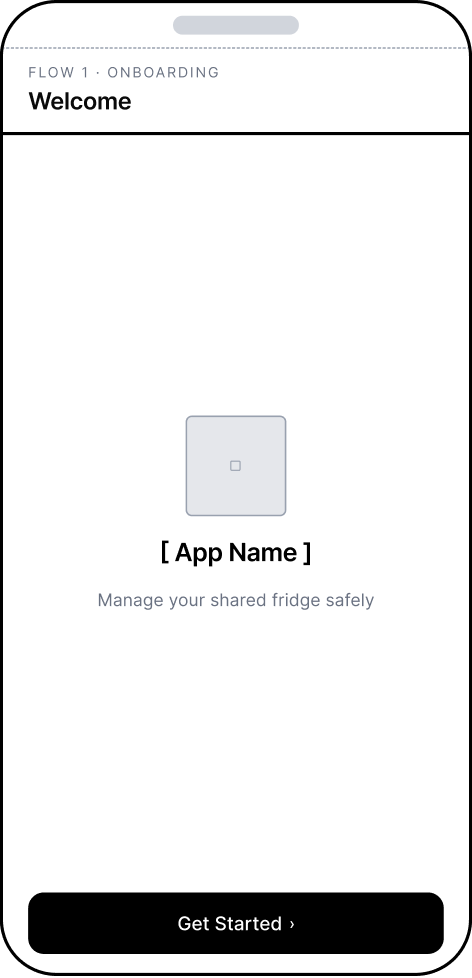
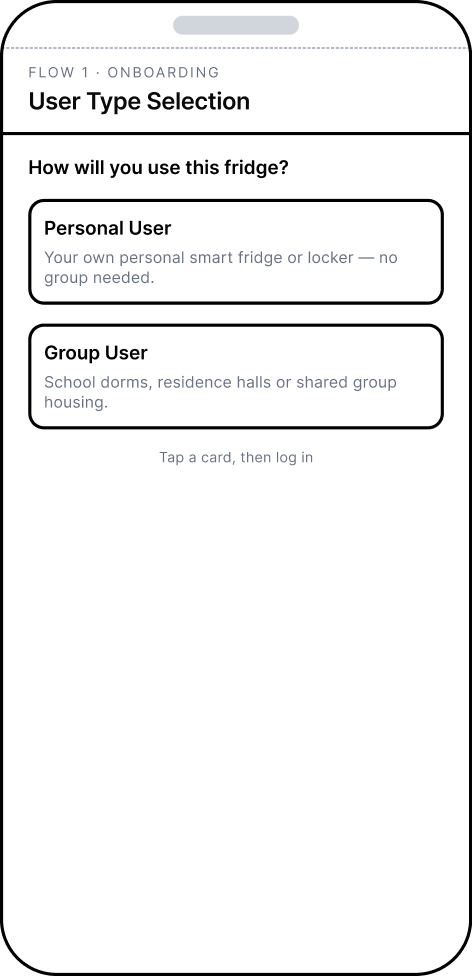
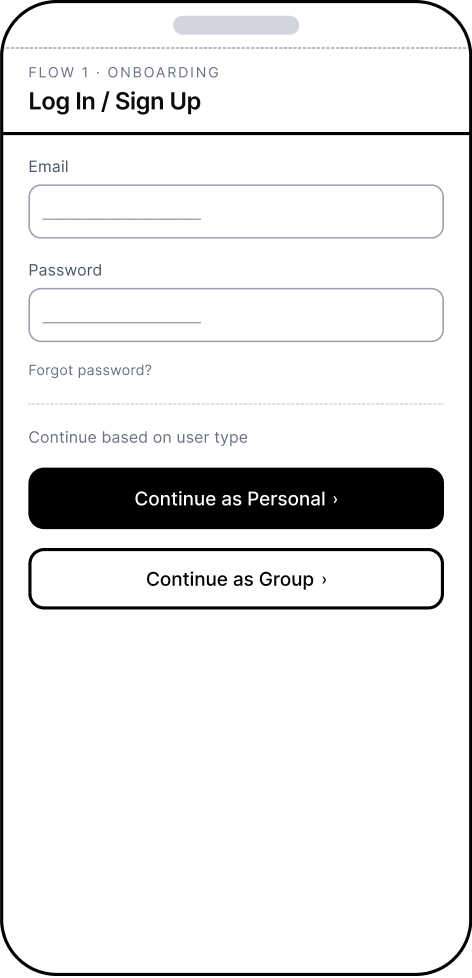
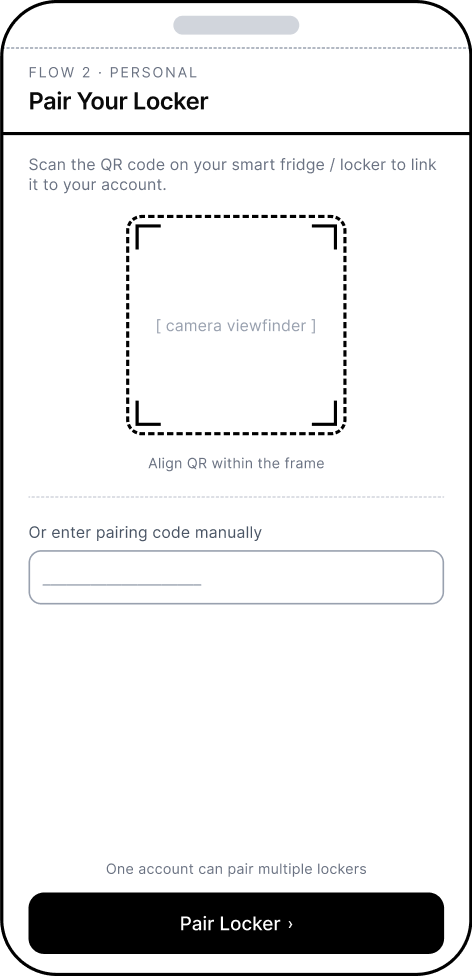
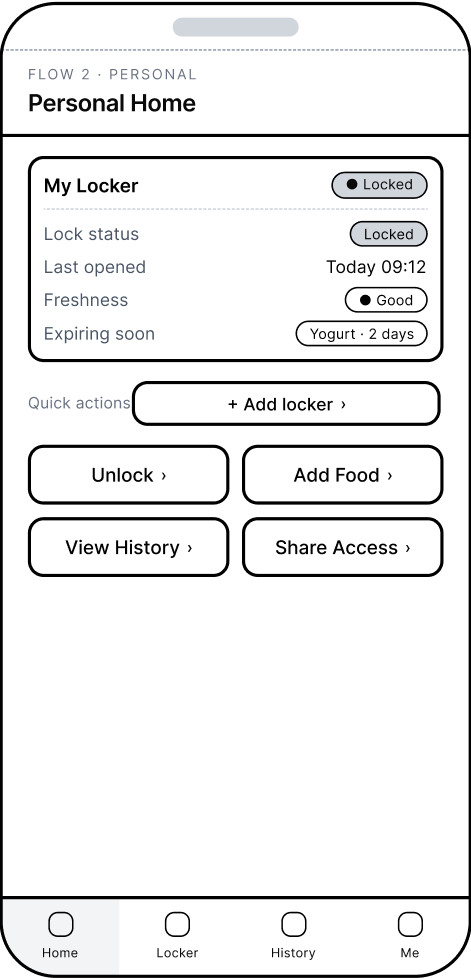
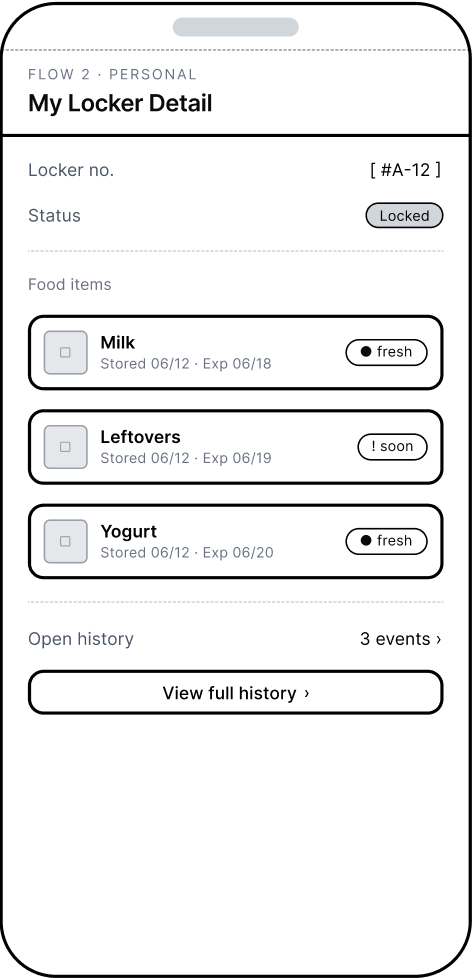
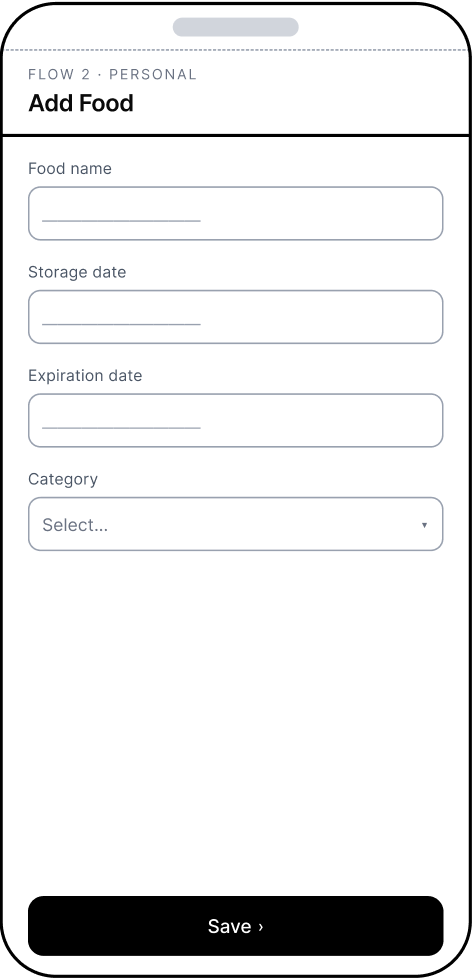
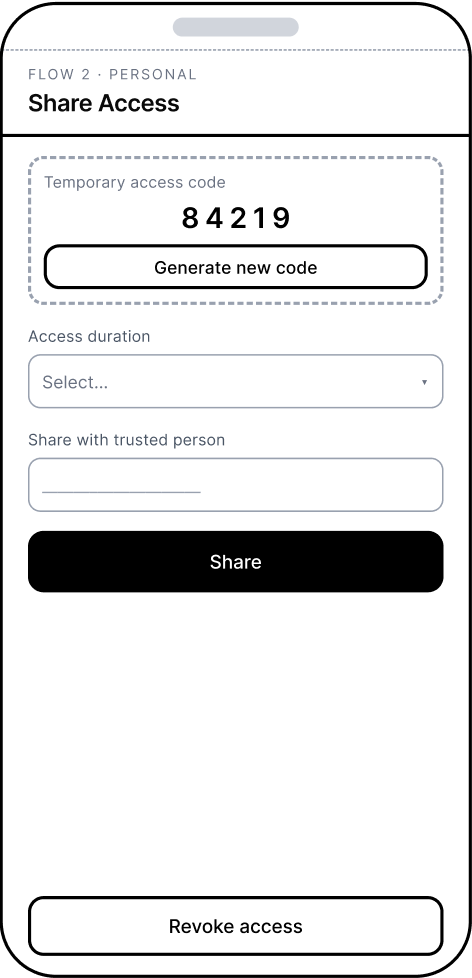
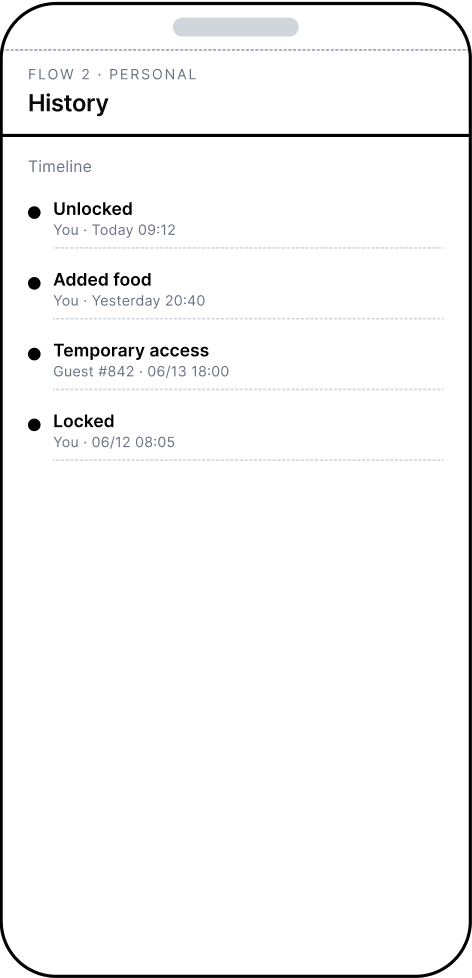
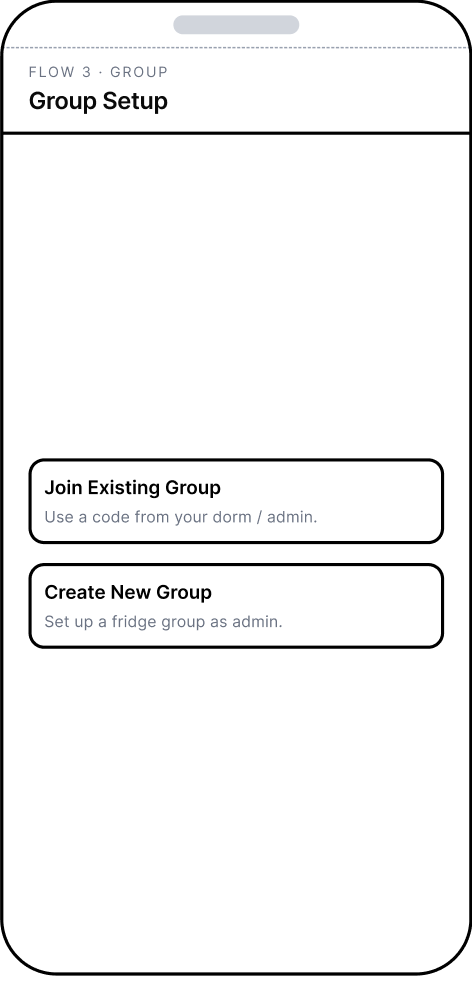
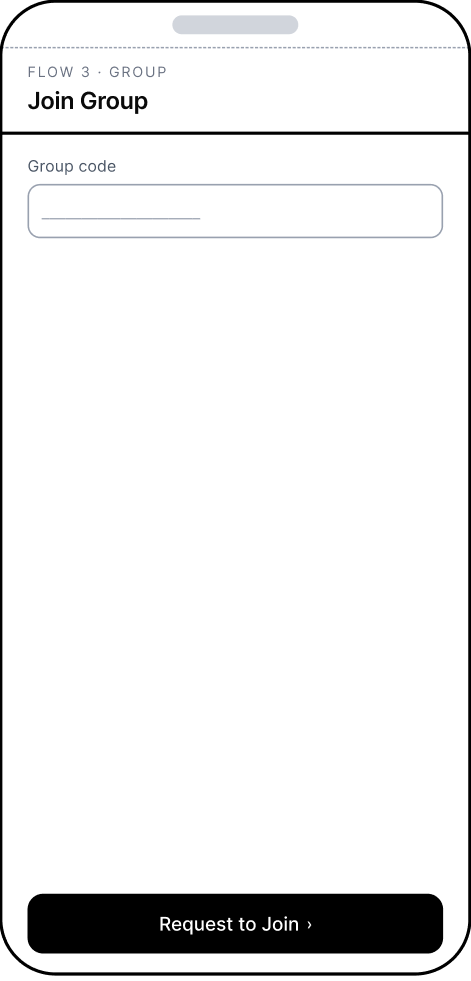
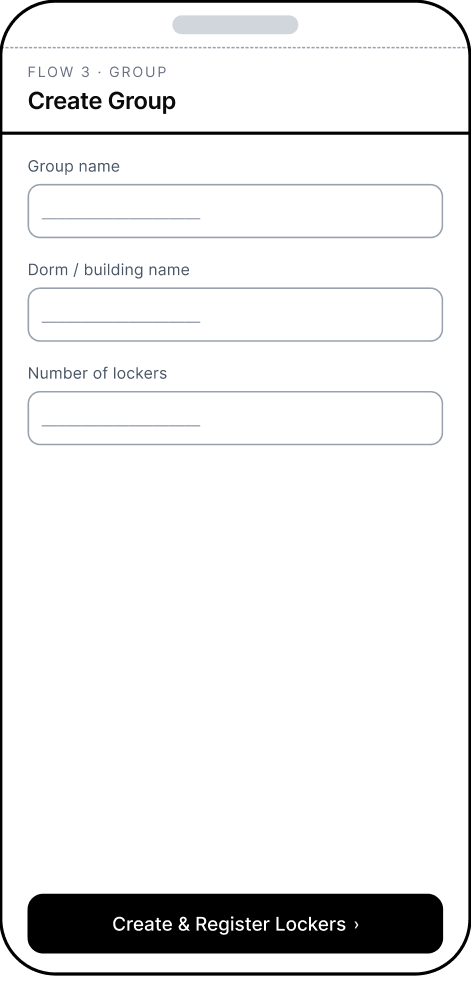
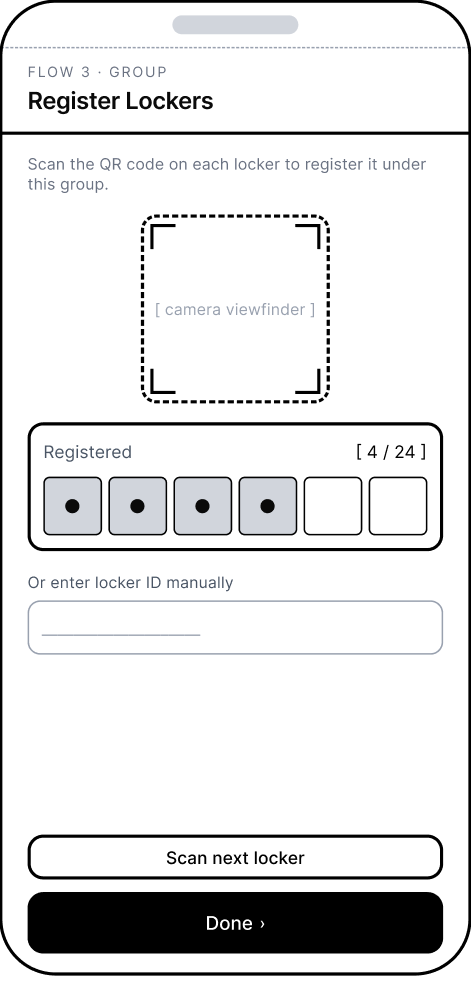
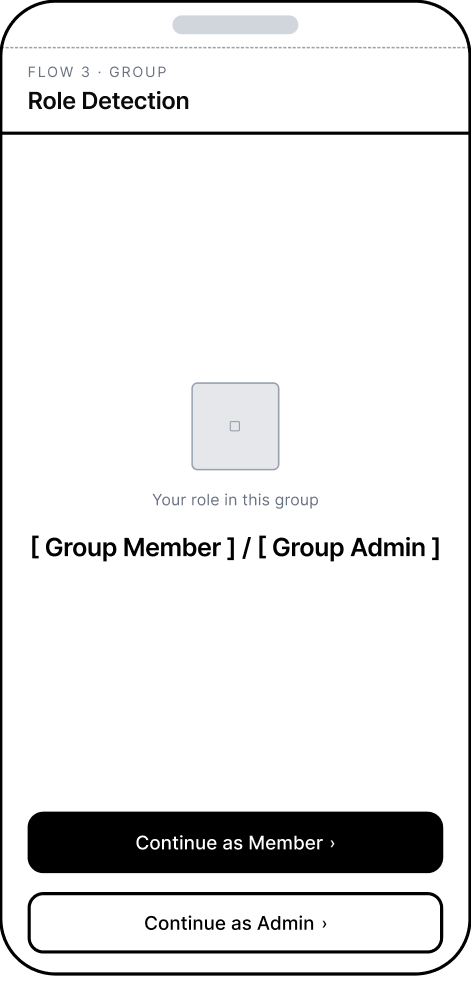
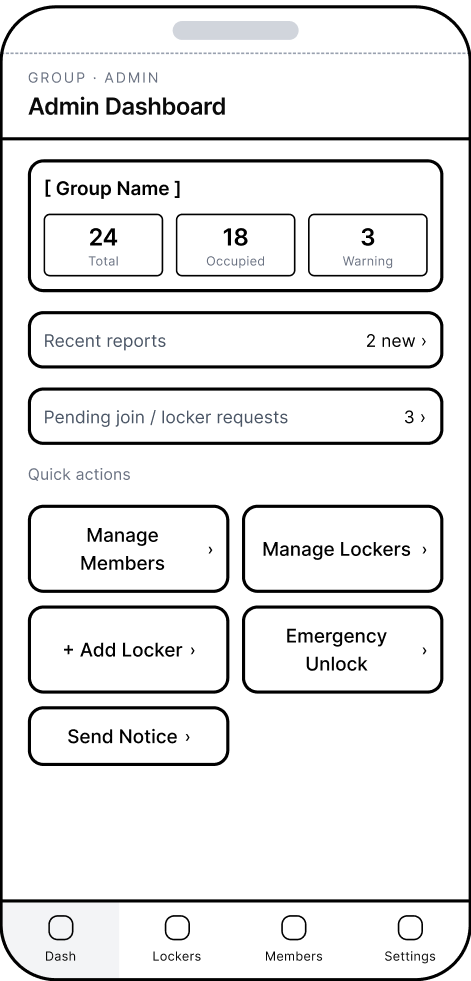
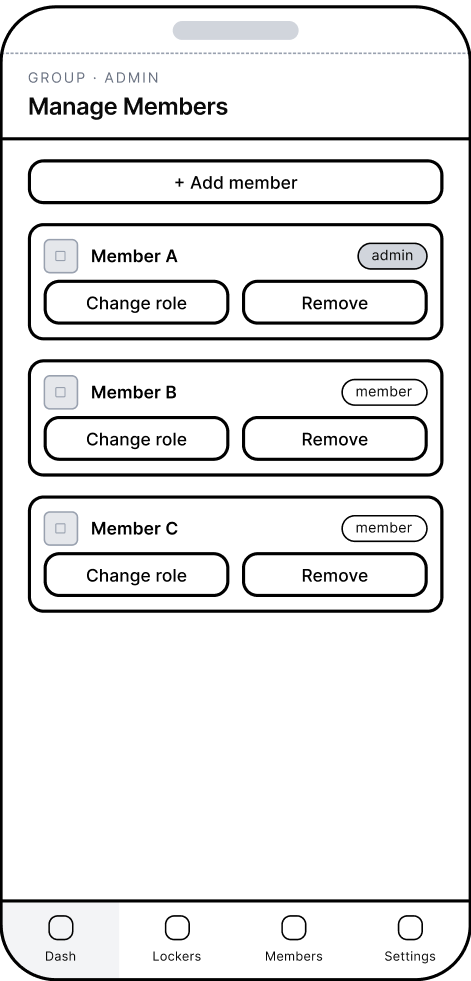
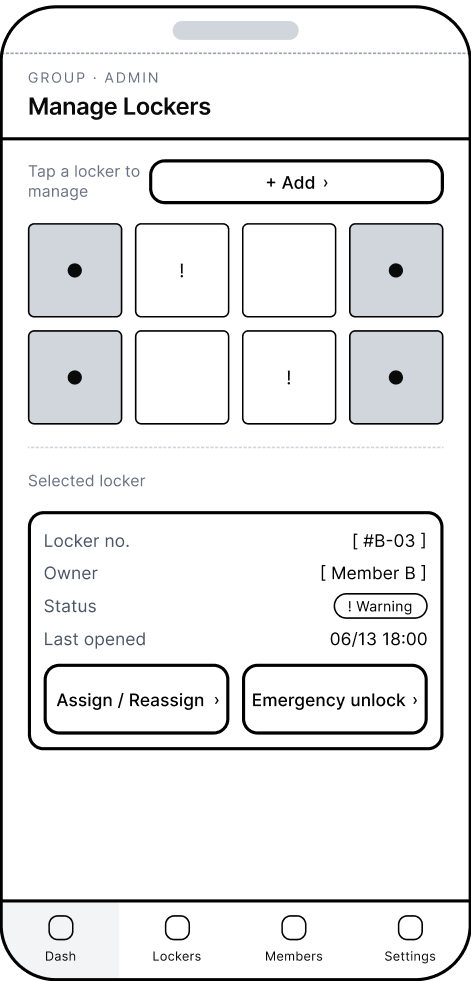
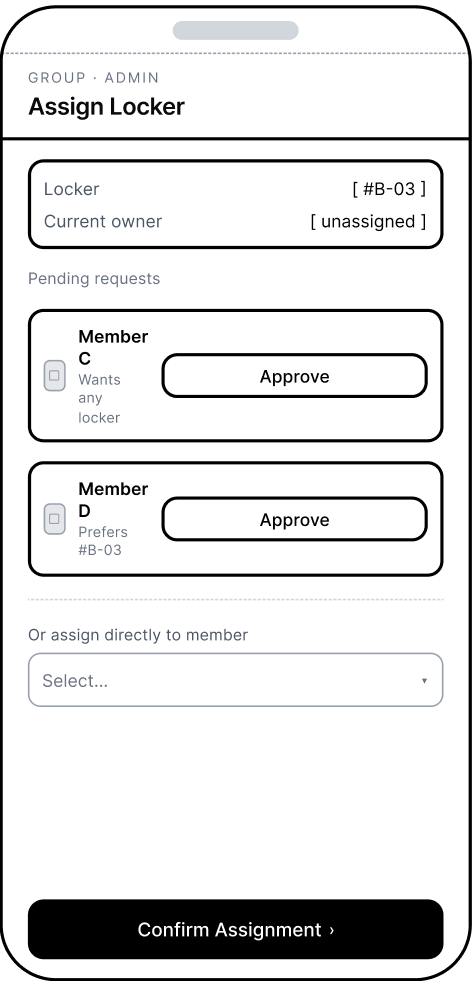
The wireframes map the core flows of the shared fridge system. Screens are grouped by function, from onboarding and personal storage to group management and safety records.

28 screensSix connected flows · Personal and group paths

01 / Onboarding & Setup

Users choose the account path, sign in, and pair a personal locker before entering the fridge system.

4 screens
Welcome wireframe
Welcome
User Type Selection wireframe
User Type Selection
Log In / Sign Up wireframe
Log In / Sign Up
Pair Your Locker wireframe
Pair Your Locker
Choose a flow above · Select a screen to zoom

11 / Refining the experience

Wireframe Iteration

Three revisions make access sharing more flexible, simplify the personal home page, and give members a clear path to request their first locker.

Revision 01

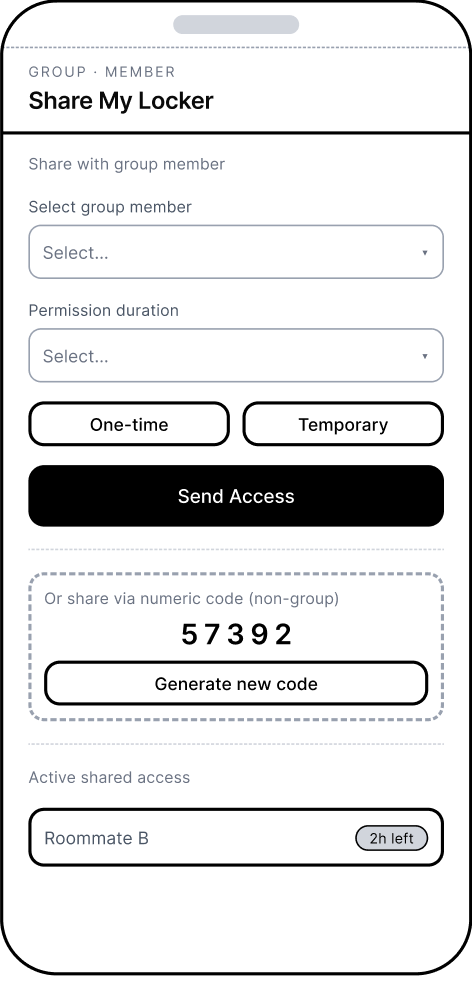
Sharing beyond the group

What needed to change

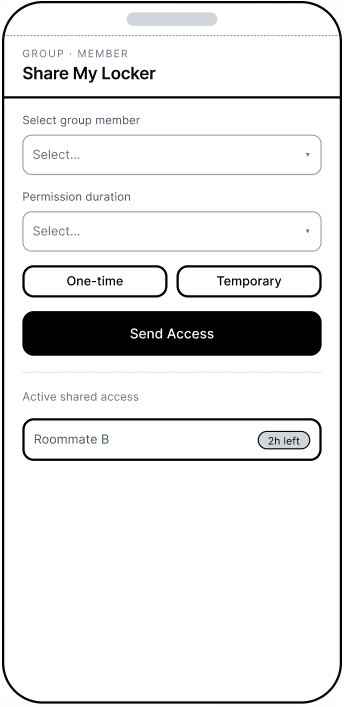
Users could only share access with existing group members. This did not support cases where a friend outside the group needed to pick up an item.

What I changed

I added a temporary access code that can be shared with non-group users to unlock the locker directly.

Before

Share My Locker — before wireframe
Share My Locker — before

After

Share My Locker wireframe
Share My Locker

Revision 02

A simpler personal home

What needed to change

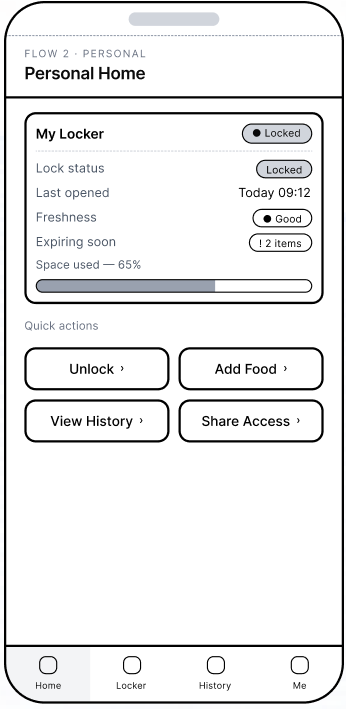
The “Space Used” indicator is not intuitive. The scanning feature also increases hardware costs without providing enough value.

What I changed

I simplified the page by removing “Space Used” and added an Add Locker shortcut for faster access.

Before

Personal Home — before wireframe
Personal Home — before

After

Personal Home wireframe
Personal Home

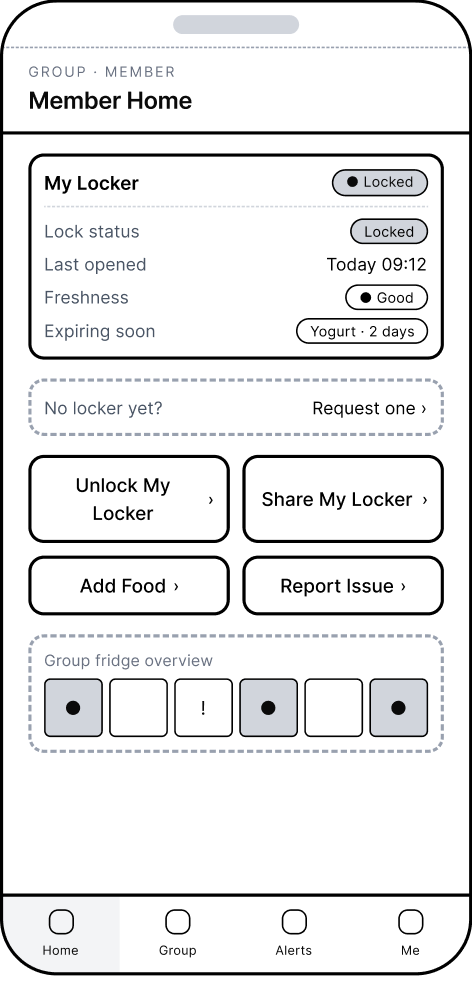
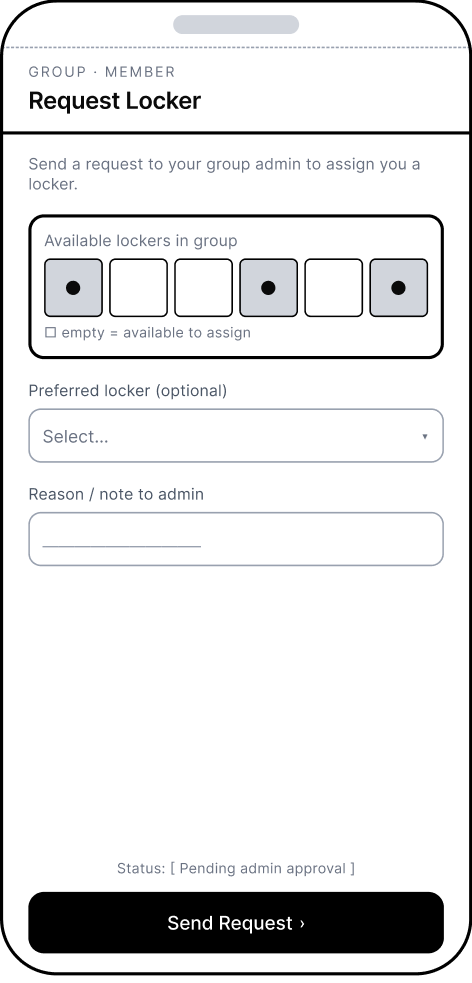
Revision 03

A clear way to request a locker

What needed to change

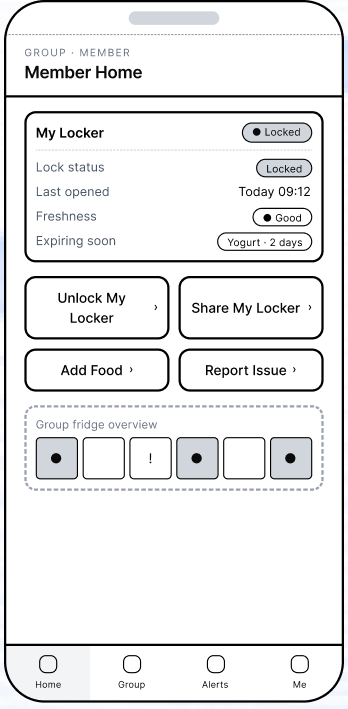
Members could log in to the group without a locker. It was confusing where to request one.

What I changed

I added a Request Locker function that guides members who do not yet have a locker to request one.

Before

Member Home — before wireframe
Member Home — before

After

Member Home wireframe
Member Home
Request Locker wireframe
Request Locker

12 / The digital experience

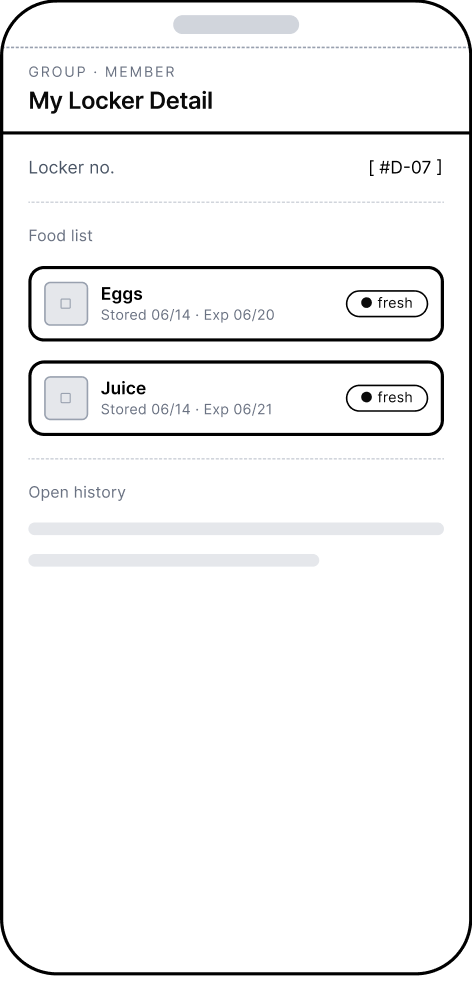
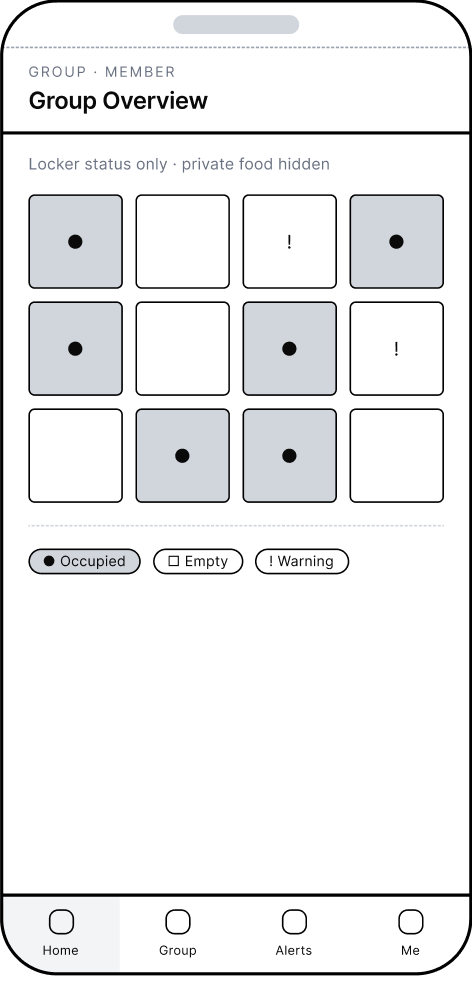
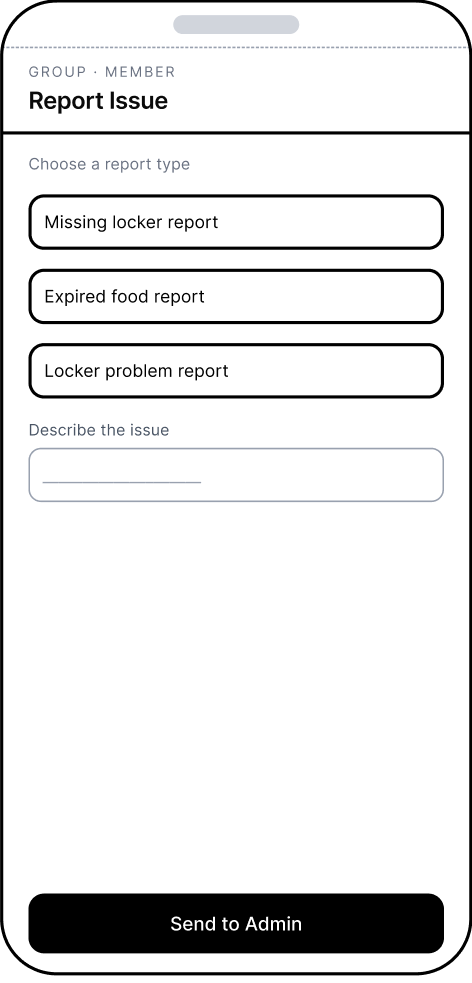
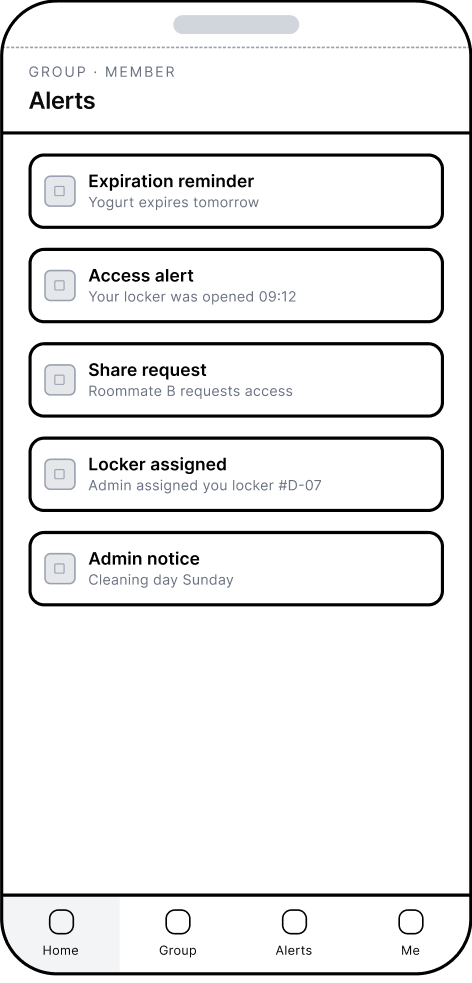
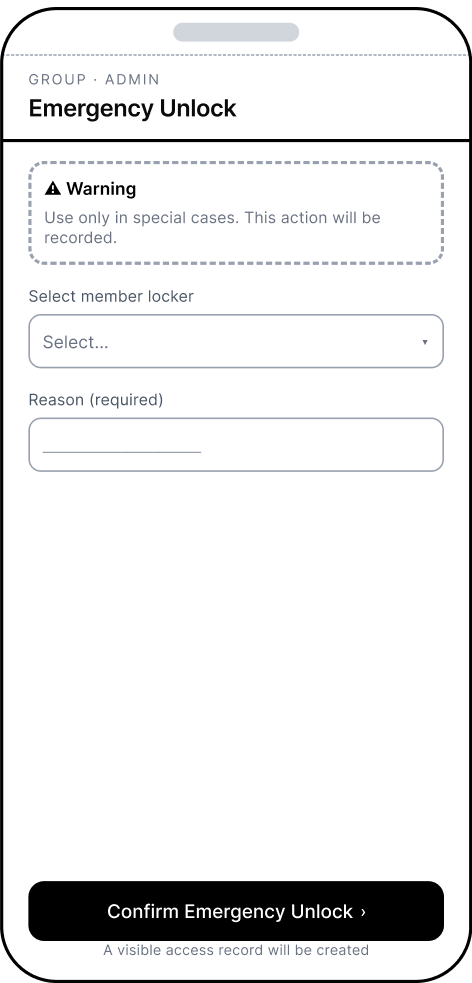
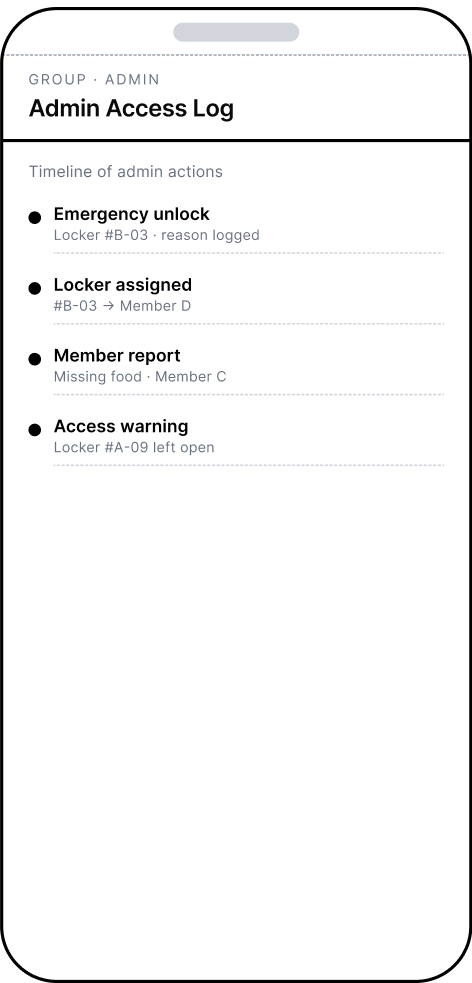
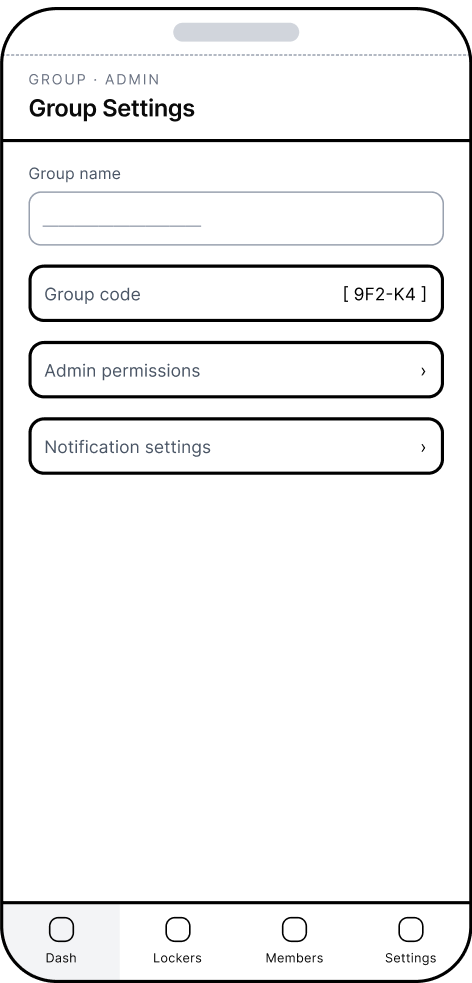
High-Fidelity Screen

A smart shared refrigerator management system. More secure. More organized. Less stress.

13 / Using FridgeKey

User Journey Map

From joining a shared fridge to managing food and resolving issues, the proposed experience connects personal ownership with shared responsibility.

14 / Listening to the proposed experience

User Feedback

Resident 1

UsefulSafer
“This would make the shared fridge feel much safer.”
The assigned locker makes ownership clear and reduces awkward roommate conversations.

Resident 2

Useful
“I like that I can see whether my locker is locked.”
Lock status and access history make food security easier to trust day to day.

Resident 3

Useful
“Temporary sharing would be really helpful. My friend could come pickup stuff when I am not home.”

A short-term code lets a friend pick up food without sharing a phone or password.

RA 1

Useful
“This gives us something concrete to check. I think it could reduce contradicts.”

Alerts and access records would make food complaints easier to follow up and document.

Resident 4

Question
“What happens if Bluetooth fails?”

The concept feels useful, but backup access and expiration reminders should be clear.

15 / From app to physical locker

Product Design

Exploring the locking mechanism, building two prototypes, testing them, and developing the locker structure.

In progress · Product development

  1. 01

    Understanding the Locking Mechanism

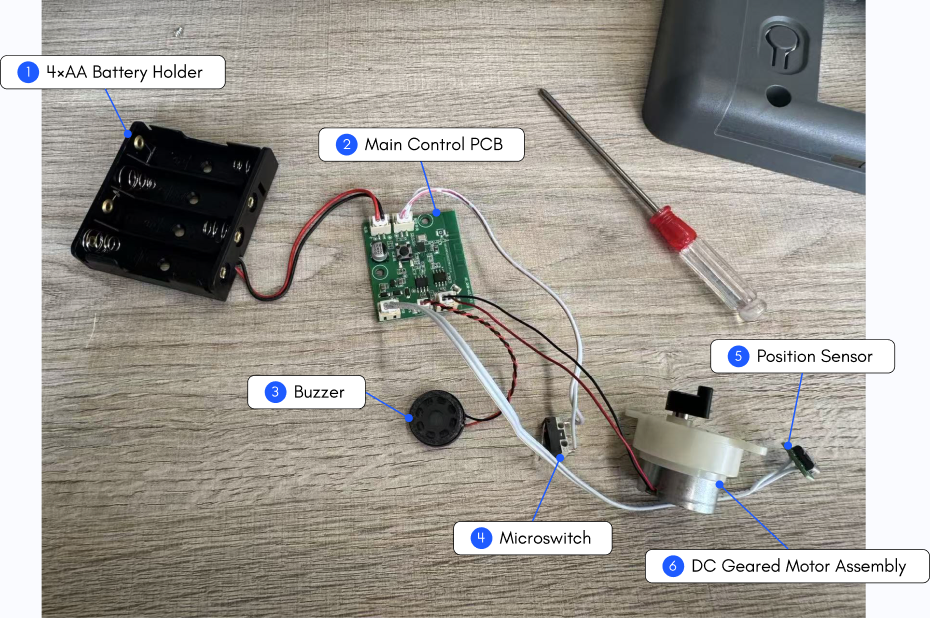
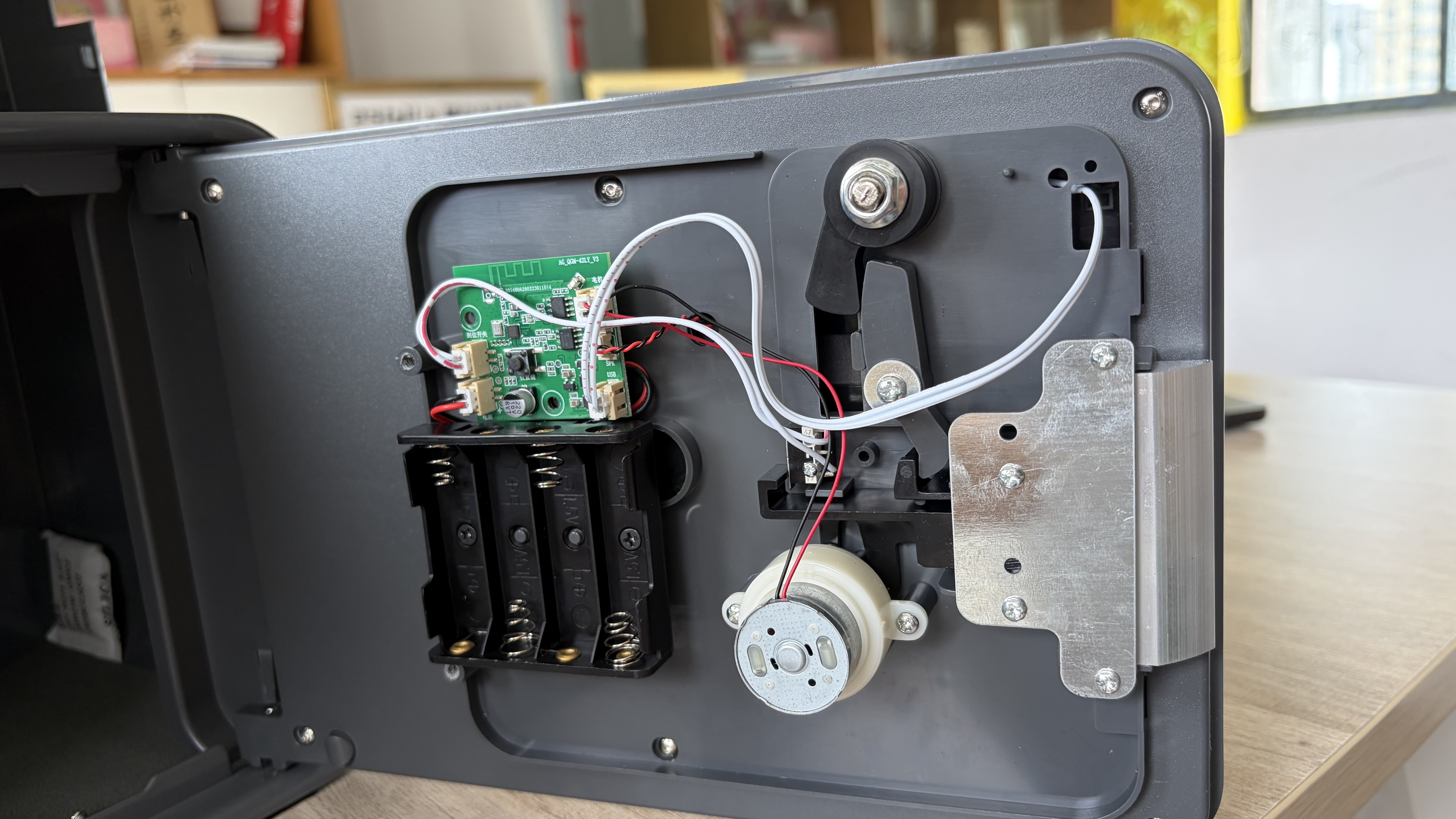
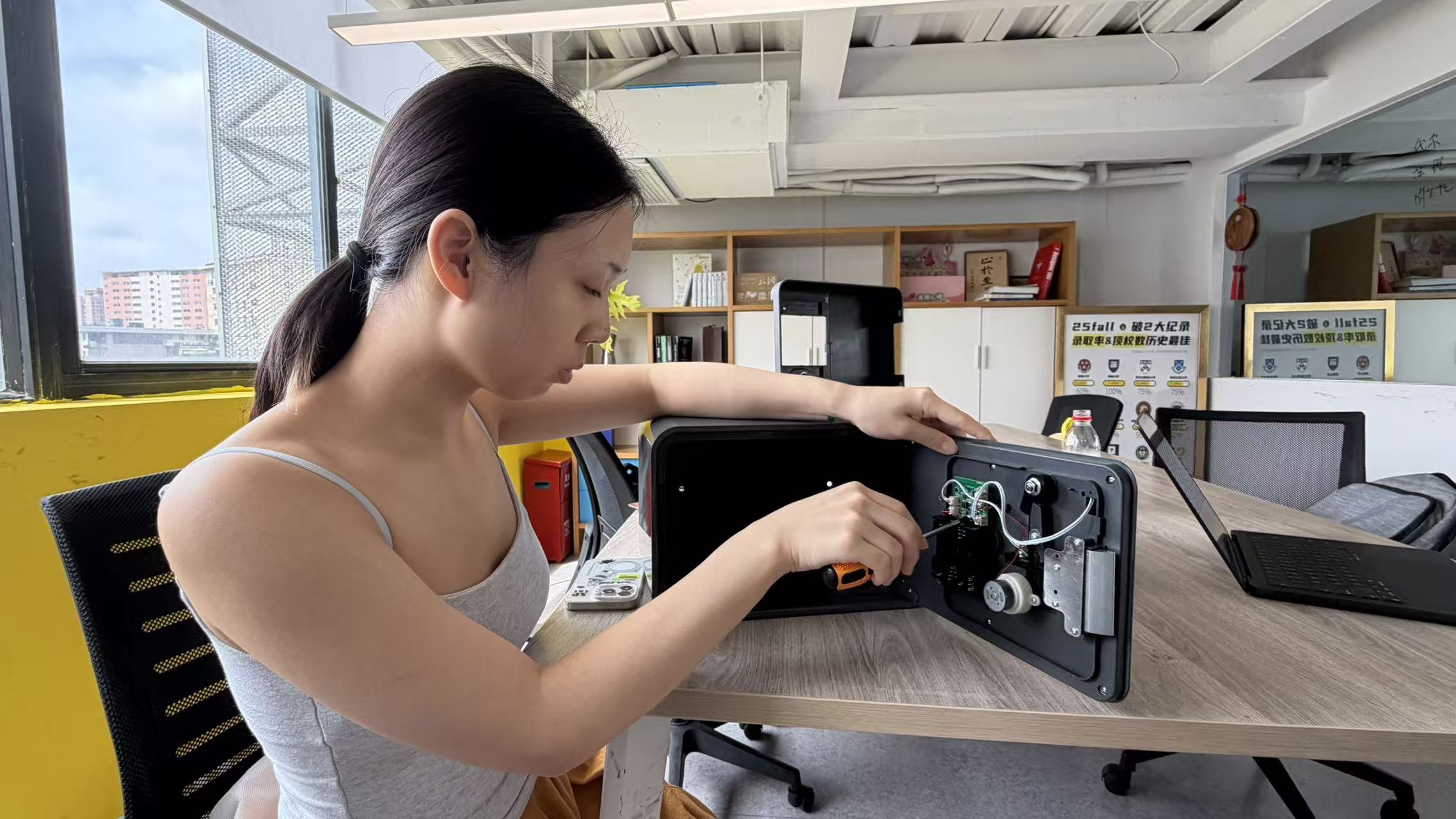
    To better understand how a smart locking system works, I disassembled a Deli’s Bluetooth safe and studied its internal structure.

    Open internal structure of the Deli Bluetooth safe
    Open internal structure
    Disassembling the Deli Bluetooth safe
    Disassembling the safe
    Annotated safe components: battery holder, control PCB, buzzer, microswitch, position sensor, and DC geared motor assembly
    Understanding how the six components work together.
  2. 02

    Building the Locker System

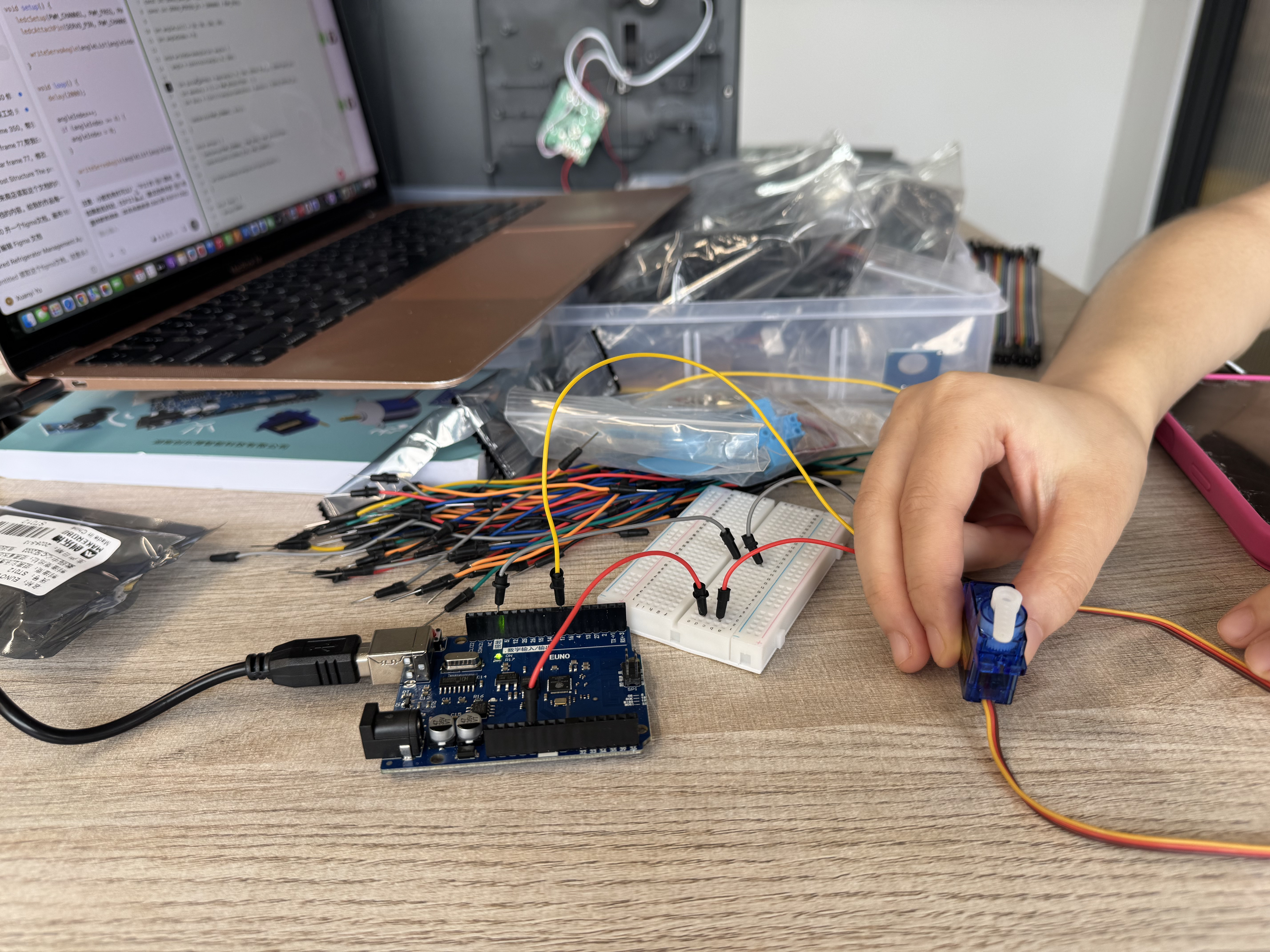
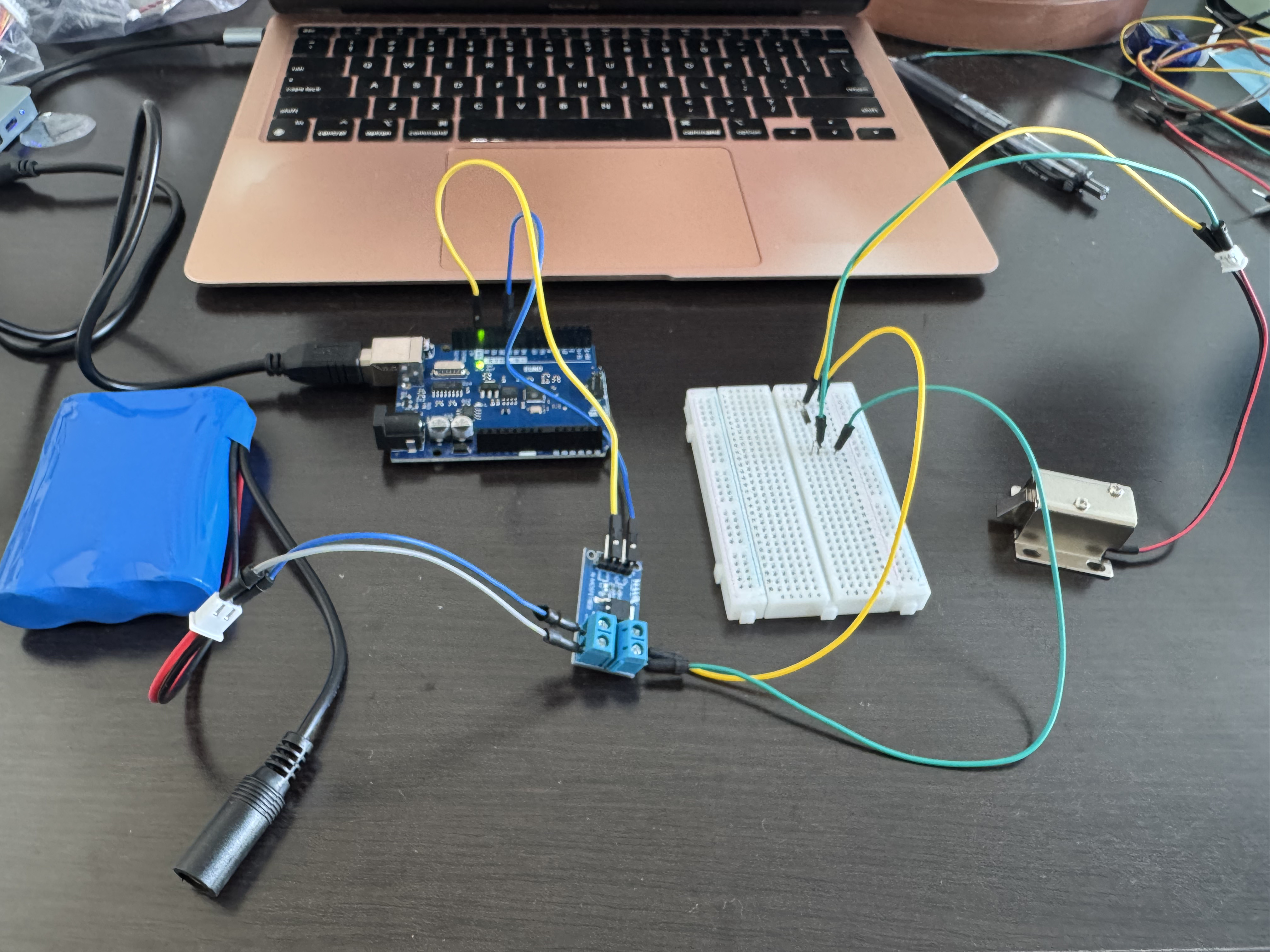
    I built two locking prototypes, one with an SG90 Micro Servo and one with a 12V electronic lock, to explore different mechanisms.

    Prototype 1: SG90 Micro Servo connected to an ESP32
    Prototype 1 · SG90 Micro Servo
    Prototype 2: 12V electronic lock connected to an ESP32
    Prototype 2 · 12V Electronic Lock
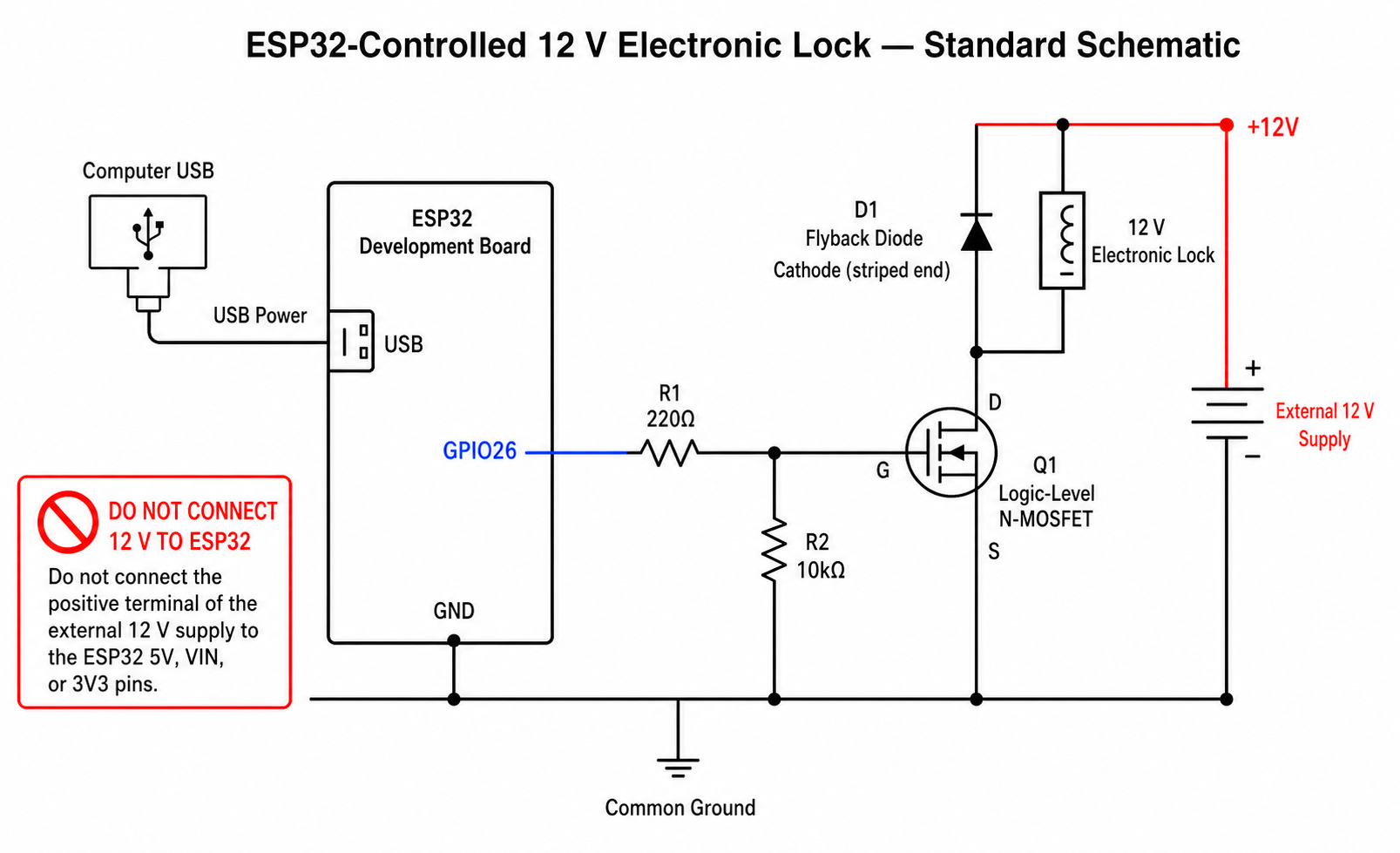
    ESP32-controlled 12V electronic lock standard schematic
    ESP32-Controlled 12V Electronic Lock — Standard Schematic
  3. 03

    Testing

    I tested both prototypes and selected prototype 2.

    Prototype 1 · SG90 Micro Servo
    Prototype 2 · 12V Electronic Lock Selected ✓
  4. 04

    Modeling

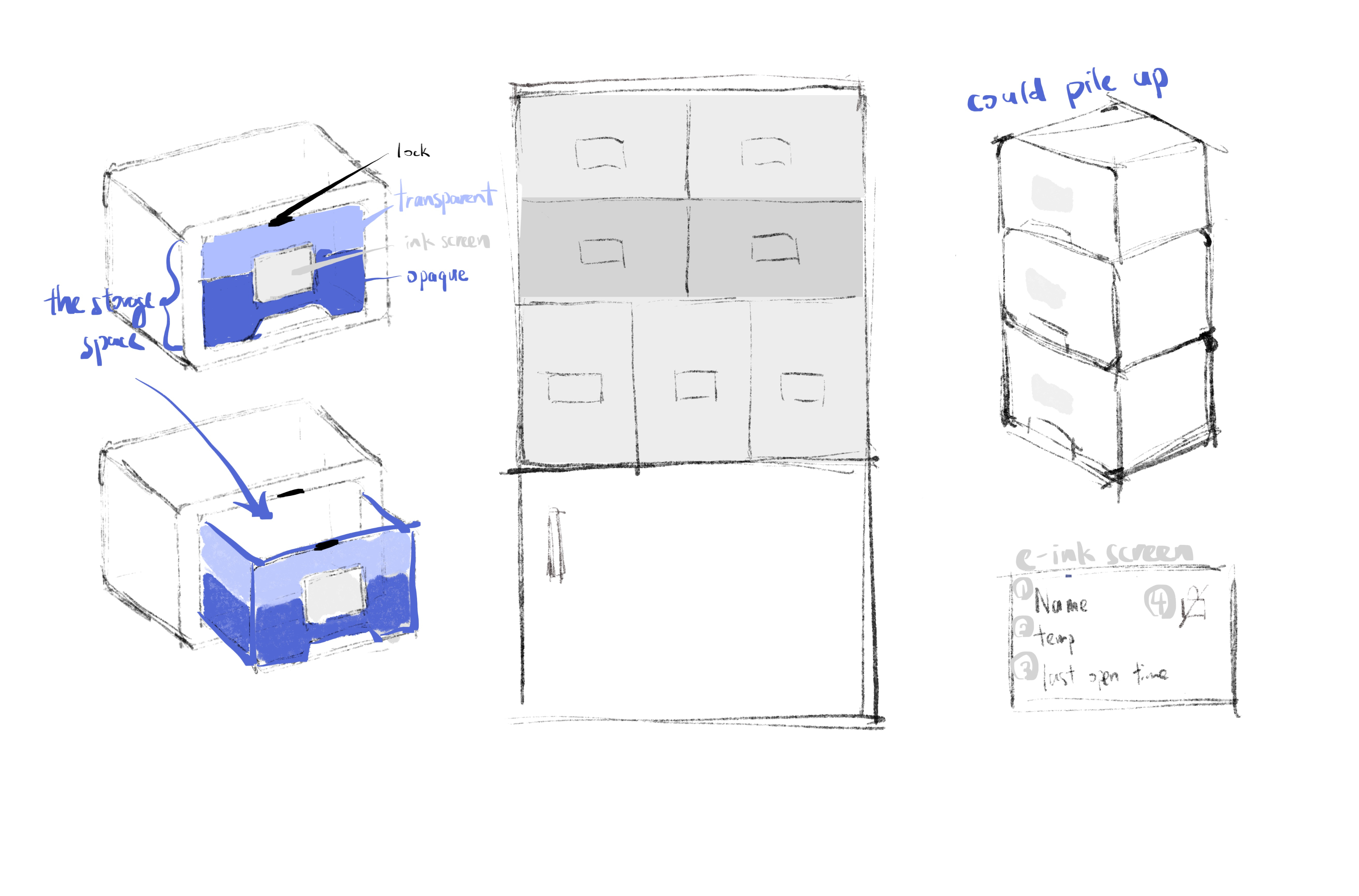
    I modeled the final locker structure based on the selected locking mechanism and component dimensions.

    Locker modeling sketches showing component placement, modular stacking, and an e-ink screen
    Locker structure and component placement studies.

16 / From prototype to production

Cost

The estimated production cost is approximately $42 per smart fridge locker. Sourcing, assembly, and modular sizing provide a path toward a lower unit cost at scale.

Strategy

  • Source hardware from China to reduce component costs and take advantage of lower manufacturing prices.
  • Vary cost by SKU and size, since different locker dimensions require different enclosures.
  • Complete final assembly in the U.S. for easier quality control, testing, maintenance, and deployment.

Cost Breakdown

USD / locker
  • 3.97″ E-Ink Display$19
  • Enclosure$13
  • 12V Electronic Cabinet Lock$2
  • ESP32 Development Board$3
  • 12V Battery Pack$4
  • Solderless Breadboard$0.30
  • MOSFET Driver Module$0.60
  • Jumper Wiring$0.10

Cost Optimization Opportunities

01

Bulk Hardware Sourcing

Bulk purchasing can significantly reduce the unit cost of individual components.

02

Integrated PCB

Components can be integrated into a single PCB during production to reduce labor costs.

03

Standardized Enclosure Sizes

Standardized sizes can simplify manufacturing and reduce enclosure production costs.

Current estimate$42
Intermediate target$35–38
Target at scale$30–35

17 / Moving toward real-world use

Future Roadmap

Based on user feedback and testing results, I will continue to refine FridgeKey and move toward real-world deployment.

  1. 01

    Address User Feedback

    Add a physical PIN keypad as a backup unlocking method, improve the app interface and onboarding, and include useful features such as expiration reminders based on user suggestions.

    Resident 04“What happens if Bluetooth fails?”

    The concept feels useful, but backup access and expiration reminders should be clear.

  2. 02

    Pilot in a Real Dorm

    Deploy FridgeKey in one residence hall for 6–8 weeks. Work with University Housing and RAs, collect usage data and feedback, and measure the impact on food conflicts and user satisfaction.

    Location
    One residence hall
    Participants
    1 fridge group (8–12 residents) + RAs
    Duration
    6–8 weeks
  3. 03

    Maintenance Team

    Through further pilot testing and real-world deployment, I could identify common maintenance needs and add a Maintenance function to the app.

  4. 04

    Evaluate Long-Term Impact

    Track key metrics over a longer period to determine whether FridgeKey reduces food theft, roommate conflicts, expired food, and RA workload, and identify areas for further improvement.

    Metrics to track

    • Number of food theft incidents
    • Expired / unclaimed food
    • User satisfaction
    • RA workload
    • System usage

    A safer shared living environment.

18 / Bringing the system to shared housing

Business Model

An institutional purchasing model allows multiple lockers to be deployed and managed as one system, with an ongoing service for each resident group.

B2B2C Go-to-Market

The target customers are institutions, including boarding high schools and university residence halls. FridgeKey is suited for dorm-wide purchasing because multiple lockers can be deployed and managed as one system.

  1. 01

    Institution

    buys + maintains

  2. 02

    Locker System

    configured by dorm

  3. 03

    Residents + RAs

    use the system

Hardware Sale Price

$40–$50

per locker module

Group Service

Subscription-based

$10 / group / month

Up to 20 residents per group

Sale Methods in Schools

  1. 01

    Pilot Program

    Start with one residence hall floor or shared group.

  2. 02

    Institutional Contract

    Expand to multiple groups after pilot testing.

  3. 03

    Scale Deployment

    Expand FridgeKey across all residence halls.

Revenue Streams

  • Hardware Sales
  • Pilot Packages
  • Installation
  • Subscription
  • Maintenance
Next projectEverPaw →

Project image

100%